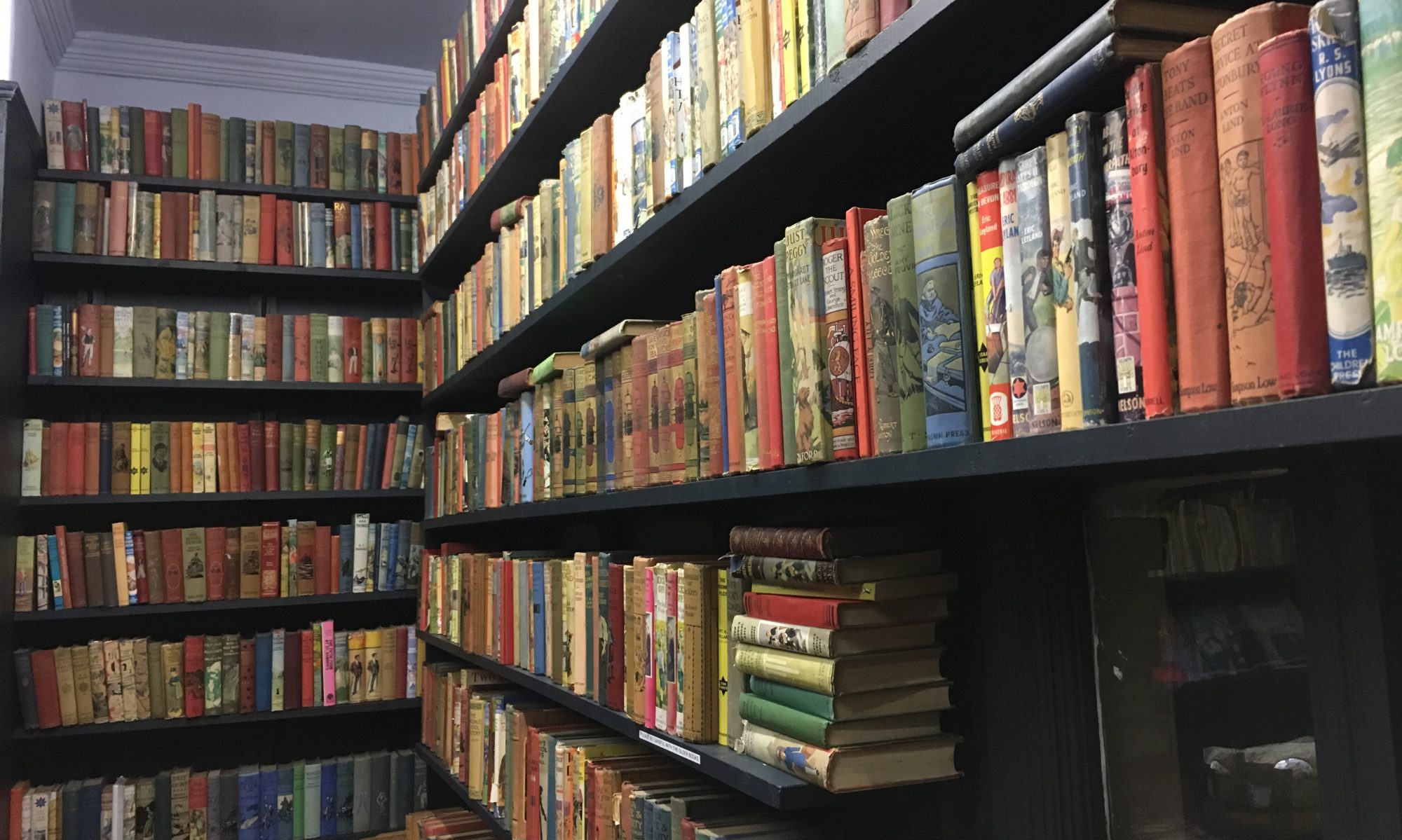

The Case of the Reluctant Eight (or Possibly Twelve, Depending on phase of the moon and current location).

a book burning in library

Frank first noticed it on a Tuesday, which is already suspicious because Tuesdays are widely understood (by those who understand anything at all) to be structurally weaker days in the fabric of reality.

A book had sold.

This, in itself, was not unusual. Books are meant to be sold, in the same way coffee machines are designed to eventually betray you. What was unusual was that the book…a perfectly ordinary, slightly damp paperback about maritime taxation in 1973, was not where it had been meticulously, lovingly, and definitely placed.

Frank checked again. And then again, but with more suspicion.

Then once more, but this time with the quiet dread of a man who has begun to suspect that the universe is not only indifferent, but actively misfiling things.

It wasn’t there.

A Working Theory of Book Evasion

By Thursday (which had begun behaving like a Wednesday wearing a fake moustache), Frank had compiled a list:

8 missing books (or 11, depending on how one counts absence)

  1. All recently ordered
  2. All previously “definitely seen”
  3. None willing to be located under any known laws of physics, filing systems, or swearing

This led to the only reasonable conclusion:

  • Books do not stay where they are put.
  • They wait.

On the Secret Lives of Books

It is widely not known (because no one who discovers it is taken seriously afterward) that books are pan-dimensional entities with literary camouflage.

Their apparent purpose… to sit quietly until purchased –is merely a social contract they have no intention of honouring.

In reality:

A book exists simultaneously in:

  • your shelf
  • a secondary archive dimension (often mistaken for “I’ll check later”)
  • and a migratory holding pattern known as The Pending

When ordered, a book must decide:

  1. Do I go?
  2. Do I vanish briefly to increase mystique?
  3. Do I refuse entirely and test this human’s psychological stability?

Most choose option 3. It’s the funniest.

The Wormhole Hypothesis

When a book is ordered, a small, polite wormhole opens behind it.

Not flashy. Not sci-fi. More like the kind of gap you’d ignore behind a wardrobe because you’ve got other things on.

The book slips through.

Where does it go?

Reports vary, but leading theories include:

  • The Library of Alexandria (Expanded Edition)
  • Not destroyed—just relocated to a dimension where overdue fines are metaphysical.
  • The Moon (Back Office)

The visible moon is just the public-facing shell. The inside is shelving. Endless shelving with no catalogue.

  • The Customer Assessment Layer

Books sometimes wait to see if the buyer is worthy. (Criteria unclear. Possibly vibes.)

Dear customer

Why the Book you ordered is unavailable?

Statistically, it shouldn’t always be the missing ones that sell.

But statistics assumes:

  • Books are inert
  • Reality is stable
  • The bookseller is not in a narrative

All three are demonstrably false.

What’s actually happening is:

  • The books that want to leave don’t get ordered
  • The books that refuse to leave get ordered repeatedly
  • You are caught in a feedback loop of narrative inconvenience

Frank, at this point, recognised this immediately as:

“Classic low-level cosmic admin sabotage.”

He set his mind to finding the creature critter responsible, he searched for his Encyclopaedia of Visitors. He couldn’t find it.
Nearly Sorted

There was a bookshop run by a woman who was almost never in it, on a street that had once been on maps before paper fell out of fashion.

Strictly speaking, this was not a problem, because the sign in the window, handwritten, uppercase, in blue sharpie, always reassured passers-by:

BACK IN 7 MINUTES

Occasionally the number changed. Sometimes it was 3. Once it was 11½, which caused a minor philosophical incident involving a man from the council and a sandwich. But the essential promise remained: she would be back. Shortly.

She was not.

The woman (whose name varied depending on which invoice she was ignoring), was, at any given moment, elsewhere. Whether this “elsewhere” existed in the physical sense or was merely a well-furnished annex of her own mind was difficult to determine and, for tax purposes, inadvisable to pursue.

What could be confirmed is that she had a number of jobs.

Not jobs in the traditional sense, where one goes somewhere and does a thing and receives money that corresponds vaguely to the thing. These were gig economy jobs, which meant they were:

  1. Temporary
  2. Poorly explained
  3. Slightly insulting to the concept of labour

For instance, on Tuesdays (or what she referred to as Tuesdays, though the calendar had long since stopped agreeing), she worked as a mixologist, crafting elaborate mocktails for people who wished to feel decadent without the administrative burden of actual intoxication. Except they added alcohol.

Her most popular creation was called The Absent Proprietor: crushed ice, lime, something floral, and a garnish of mild regret.

On Wednesdays she was paid to be a Bad Conversationalist, a role in which she would attend corporate events and respond to everything with phrases such as:
“Hmm,”
“That’s interesting,”
and
“I suppose it depends what you mean by ‘meaning.’”

Demand for this was inexplicably high.

On alternate Thursdays she was employed as a Person Who Plugs Things In, which involved arriving at offices where nothing worked, plugging in several obvious cables, and leaving before anyone could ask deeper questions about existence or IT support.

Fridays were reserved for Therapist to Out-of-Work Actors, where she would sit in a room with individuals who had once been teachers, policemen, or the concept of longing in fringe productions, and gently reassure them that their greatest role was yet to come, ideally in a context that provided snacks.

Other engagements included:

  • Ashtray Emptier (Ceremonial)
  • Barrel Roller (Non-Union)
  • Polystyrene Picker Upper (Advanced Level)

The last required certification.

Meanwhile, back at the bookshop (which may or may not have been real, but certainly paid bills), the sign continued its quiet, persistent lie.

BACK IN 5 MINUTES

Inside, the books waited with the patient disappointment of objects that had been promised purpose. They had been arranged once, possibly alphabetically, though over time the system had evolved into something more expressive:

  • Conspiracy under non-fiction
  • Non-fiction under esoteric
  • Esoteric under “Miscellaneous Feelings”

Customers came.

They knocked.

They peered.

They left notes.

The notes were slipped under the door, polite at first:

“Hello, I’m looking for a copy of something by… I can’t quite remember but it has a blue cover…”

“Do you stock non-linear local history?”

“Are you… open?”

These enquiries were always answered.

Not directly, of course. That would be absurd.

Several days later, each customer would receive a reply—sometimes by email, sometimes by post, once via a small, determined pigeon—containing a carefully formatted recipe for a mocktail.

Dear Sir,
Thank you for your enquiry.
Have you considered the following?

The Bitter Index

  • 50ml something citrus and strong
  • 10ml syrup (optional optimism)
  • 50ml something random
  • Shake until resolved

Best wishes.

No further explanation was provided.

Over time, a small community formed around the shop. Not all readers, but people who had received these recipes and felt, somehow, answered.

They began to gather outside.

They compared notes.

They debated whether the woman existed, or whether the shop itself was simply a manifestation of deferred intention or perhaps a place where things almost happened, perpetually.

One man insisted he had seen her once, rushing past with a crate of limes and a look of profound distraction.

Another claimed she had been inside all along, just slightly out of phase with the rest of reality.

This was considered plausible.

The sign, meanwhile, had settled into a comfortable rhythm:

BACK IN 2 MINUTES

It had said this for three weeks.

No one removed it. It had achieved a kind of authority.

Inside the shop, a single book lay open on the counter. Its pages fluttered occasionally, as if in response to a breeze that could not be sourced.

If one looked closely (though no one could, as the door remained locked) one might have noticed a small handwritten note in the margin:

“Must come back. Nearly sorted.”

The books slipped through time and space into another dimension, and the bookshop promptly became a pharmacy.

The Algorithm Hates Books

a book burning in library

How the rage machine swallows nuance and quietly punishes readers, writers, and sellers

Once upon a timeline, books were the centre of cultural discussion. Now? Scroll too fast and the algorithm might spit you out before you can finish the title. If you’re an author, bookseller, or reader trying to exist online (especially on platforms like X) you’ve probably felt it: the sense that long form thought is being quietly smothered.
And you’re not wrong.

The Invisible Algorithm

The X algorithm is designed not for depth but for “engagement.” But engagement doesn’t mean curiosity or thought… it means reaction. Rage. Conflict. Polarisation. It rewards the loudest, not the smartest.

Books don’t fit neatly into that system. They require time, attention, nuance. All things that slow a scroll. And so, they’re pushed aside by the system itself – maybe not out of malice, but out of misalignment.
But what happens when algorithms actively punish book content?

Shadowbanned by the Scroll Gods

Shadowbanning (or “limited visibility”) is real. Sellers and writers have reported posts vanishing from feeds, or being throttled without explanation. Even when people want to engage, they often don’t see the post.

If a book post doesn’t spark a hot take or a pile-on, it can be buried… no matter how good or relevant it is. A viral moment isn’t enough. You need sustained chatter, over time, across accounts. And that’s hard to fake or force – especially with niche or thoughtful material.

One Viral Post ≠ Sales

Even when a book does get discussed, it doesn’t always translate into sales. The algorithm might surface a controversial opinion about a book, not the book itself. The conversation spirals, the post trends… and nobody clicks the link.

This is where authors and sellers feel stuck. How do you sell a book when the system wants memes and meltdowns, not context or care?

The Machine Prefers Mayhem


Social platforms want you to stay on the platform. Clicking away to read a blog post? Buy a book? Watch a long interview? That’s friction. That’s bad for ad revenue. So instead, they feed the extremes and throttle the nuance.

The result: books struggle for oxygen. Writers burn out trying to “market themselves.” Bookshops drown in silence while trolls trend effortlessly.
________________________________________

What Can Be Done?

1. Blog anyway. Search engines still love substance. People still find things off-platform.
2. Diversify your reach. Don’t rely on X. Use newsletters, videos, or wherever people are still allowed to think.
3. Name the problem. Meta-commentary is content. Talk about the suppression itself. You’re not imagining it ~ and others are noticing too.
________________________________________

“The algorithm wants heat, not light. But books are still a slow fire.”
Let’s make space for them ~ together and stop the algorithm from making us all boring…
Follow this link for recommended reads about algorithms.

Books the Algorithm Hates (and You Should Probably Read Anyway)

How to become ungovernable by reading slow, deep, thoughtful things

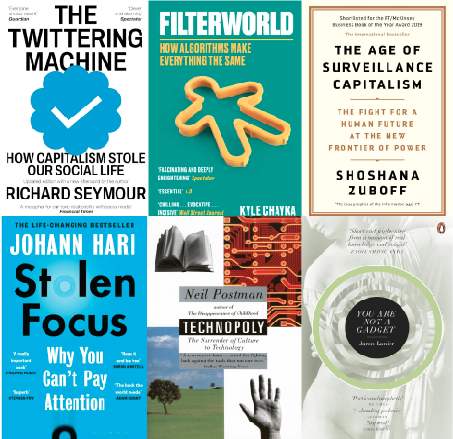
six books on Amazon about the algorithm technology and culture.
Books about the algorithm

________________________________________
1. The Age of Surveillance Capitalism by Shoshana Zuboff
Why it gets buried: Too long. Too true. Too terrifying. Also, it uses big words and makes tech bros uncomfortable.
Buy here (affiliated link)
________________________________________
2. Filterworld: How Algorithms Make Everything the Same by Kyle Chayka

Why it gets buried: Algorithms flatten culture, reduce complexity, and quietly decide what we get to see.
Why it belongs: If you’ve ever wondered why the weird stuff doesn’t go viral anymore ~ this is the answer.
Buy here (affiliated)
________________________________________
3. The Twittering Machine by Richard Seymour
Why it gets buried: It’s about how we’re all trapped in a loop of doom-scrolling for meaning.
Buy here, (affiliated link)
________________________________________
4. Stolen Focus: Why You Can’t Pay Attention by Johann Hari
Why it gets buried: It points at tech, capitalism, and our own bad habits. No one wants to admit that.
Buy here, (affiliated link)
________________________________________
5. Technopoly: The Surrender of Culture to Technology by Neil Postman
Why it gets buried: Old-school but prescient. Doesn’t praise innovation for innovation’s sake.
Buy here, (affiliated link)
________________________________________
6. You Are Not a Gadget by Jaron Lanier
Why it gets buried: The guy helped build the digital world, and now he’s like “actually this might be bad.”
Buy here, (affiliated link)
________________________________________

If you want to resist the algorithm, start by reading the stuff it ignores. Then talk about it somewhere the algorithm isn’t watching (yet).
________________________________________

And here’s a bonus article written by a real writer Max Read (and not a tired bookseller cobbling links together for clicks) about the second book in the list Filterworld: How Algorithms Make Everything the Same by Kyle Chayka. There are some other links to some other good books and blogs on there too,

Affiliate links help support small bookshops and independent creators. If you purchase through the above links, I may earn a small commission at no extra cost to you ~ and it helps me keep my bookshop open. Many thanks for your support. You can also search anything on Amazon here and that might score me a sip of coffee 😉

2020 – what the what?

The Challenges of Transitioning Online

The pandemic was an incredibly challenging time for independent businesses, and Border Bookshop was no exception. Even before 2020, we faced difficulties with declining footfall and rising costs, compounded by high-interest rates on loans. When lockdowns made in-person shopping impossible, we had to make the difficult decision to shift our stock online while also physically moving all of the stock to an alternative premises to continue serving our customers.

While we’ve made progress, moving thousands of books, comics, and magazines to an online database has been an immense task. Years later, we’re still not even halfway through cataloguing everything. This means there are countless single-issue comics, vintage magazines, and unique treasures that aren’t yet listed online.

For now, the best way to discover what we have is to reach out to us directly. If you’re hunting for something specific or curious about our stock, just send us an email. We’re always happy to help you find what you’re looking for, even if it takes a little extra time.

Thank you for your ongoing support—it means everything to us as we navigate these challenges and work toward preserving the magic of our collection.